
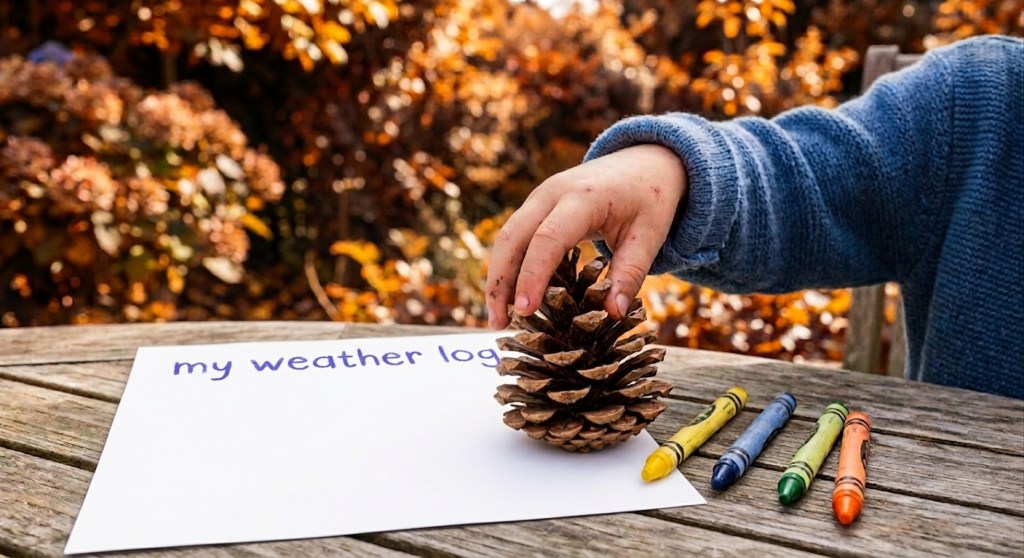
If your kids are anything like mine, their pockets come home from every trip to the park stuffed with nature “treasures.” Leaves, smooth rocks, sticks, and usually a dozen pinecones.
A few days ago, I found a pile of them sitting out in our backyard—which is funny, considering we don’t even have pine trees back there! They must have been hauled home one by one on our recent walks.
Instead of just sweeping them into the trash can, I decided we were going to turn them into a quick outdoor experiment.
It turns out, pinecones are nature’s own weather forecasters.
If you need a 15-minute activity that gets the kids off screens, uses zero fancy materials, and actually makes them think, here is how to build a Pinecone Weather Station right on your back porch.
What You Need
You probably have all of this within arm’s reach right now:
- 2 or 3 dry, open pinecones
- A small bowl of water
- A sunny spot outside (a porch, patio table, or windowsill works great)
- Paper and crayons or markers for your kids to keep track of what happens
How to Set It Up
1. The Quick Water Test (5 minutes)
Before setting up your station outside, show your kids how fast pinecones react to moisture. Take one open pinecone and dunk it into a bowl of room-temperature water.
Have your kids make a prediction: Will it stay open, or will it change?
Check back in about 30 to 45 minutes. The scales will have tightly clamped shut. Kids love seeing this change happen right before their eyes—it feels like a magic trick, but it’s pure science.
2. Put Your Station to Work
Now, set a couple of dry, open pinecones outside on a porch railing, an outdoor table, or an exterior windowsill where your kids can see them through a window.
3. Track the Weather
Have your kids check on the pinecones every morning or right before you head out for the day.
- Scales wide open? Clear, dry weather is on the way.
- Scales starting to close tight? Rain or high humidity is in the air.
The “Parent Pitch”: How to Explain the Science
You don’t need a degree in botany to explain what’s happening here. When your kids ask why the pinecone is moving, here is the simple breakdown:
Pinecones exist to protect and spread tree seeds.
- When it’s dry: The wind can easily carry seeds far away from the parent tree so new trees can grow. The pinecone opens its scales wide to release them.
- When it’s wet or rainy: The seeds would get heavy, drop straight down, and rot in the mud. So, the pinecone tightly closes its scales to protect the seeds inside until dry weather returns.
Even after a pinecone falls off the tree and gets carried clear across the neighborhood into your yard, the cells inside the scales still react automatically to moisture in the air.
A Few Easy Tips to Keep It Fun
- Keep a daily chart: If you have early elementary kids, draw a simple two-column page in a notebook where they can sketch the pinecone (open vs. closed) next to a drawing of today’s weather (sun vs. rain cloud).
- Make sure they start dry: If your kids gathered the pinecones right after rain, they might already be closed. Just stick them on a paper towel inside for a few hours until they open back up before starting.
It’s low mess, completely free, and gives them a quick reason to look closely at how nature works right outside your back door.

