

We just discovered 4M Green Science’s experiments kits and were super excited to try them out. These kits are affordably priced (~$15 to $20) and look like a lot of fun. They offer amazing experiments that we never would have imagined doing at home, like building a salt powered robot!
To see if these kits hold up to our expectations, we started with the Clean Water Science kit. The 4M Green Science Clean Water Science experiment is amazing! The educational pamphlet that comes with the kit is short and precise although I would have liked to have a little more information and illustrations!
There are 3 different experiments in this kit:
- Experiment 1 – Filtering
- Experiment 2 – Distillation
- Experiment 3 – Solar Pasteurization

The filtering experiment was our favorite. Our 7-year-old had fun mixing up the ‘dirty’ water, and to our surprise was excited to see the water come out clear after going through the filter. In fact, our son has been very interested in how water gets filtered and purified since we gave him a way too detailed explanation of where things go when we flush the toilet! This experiment was the perfect level for him.
One of our favorite things to do with science experiments is to hack them to test new hypotheses or perform additional experiments. For the 4M Green Science Clean Water Science experiment, we hacked this kit to learn about groundwater!
The Hacks
As owners of GeoKidz, we’ve always wanted to develop a groundwater experiment kit! The filtering tower, sand, and gravel provided in the 4M Green Science Clean Water Science experiment has the material for just such a thing!
Groundwater, as the name implies, is water that is stored beneath Earth’s surface. Groundwater is stored in the open spaces between rock and soil (referred to as pore space), and in fractures in rock formations. Hydrogeologist study groundwater, how it is stored, and how it moves beneath the Earth’s surface to better understand how we can both utilize and protect this natural resource. In many parts of the world, utilizing groundwater is vital for survival.
The Porosity Hack
Porosity refers to the amount of pore space in a material. The amount of water a material can hold is related to porosity since water will try and fill the empty spaces. The following experiment uses the Clean Water Science filter sections, sand and gravel.
- Use the remainder of the putty provided in the kit to close the openings on the bottom of the sand and gravel filter sections.
- Measure 15 milliliters (mL) of water. Observe that 15 mL of water will fill the filter section about half full, or about one inch from the bottom.
- Fill the filter section with the provided sand to the same line as the 15 mL of water, or about one inch from the bottom.
- Gently pour the water into the sand. Saturate the sand sample with water by getting the water as close as you can to the top of the soil without going over the top.
- Subtract the remaining volume of water from the starting volume. That shows how much water it took to saturate the soil. The volume of water used is equal to the pore volume.
- To calculate the porosity, divide the pore volume by the total volume (15 mL in this scenario). Multiply by 100 to obtain porosity expressed as a percentage.
Porosity = (Pore Volume/Total Volume) x 100%
Repeat this same process with the gravel provided in the Clean Water Science experiment. How does the porosity of the sand compare to that of the gravel?
More ideas! What do you think would happen to the porosity if you mixed the sand and gravel? Will it have a higher or lower porosity than the provided gravel? What does this tell you about the effects of grain size on porosity?
Permeability
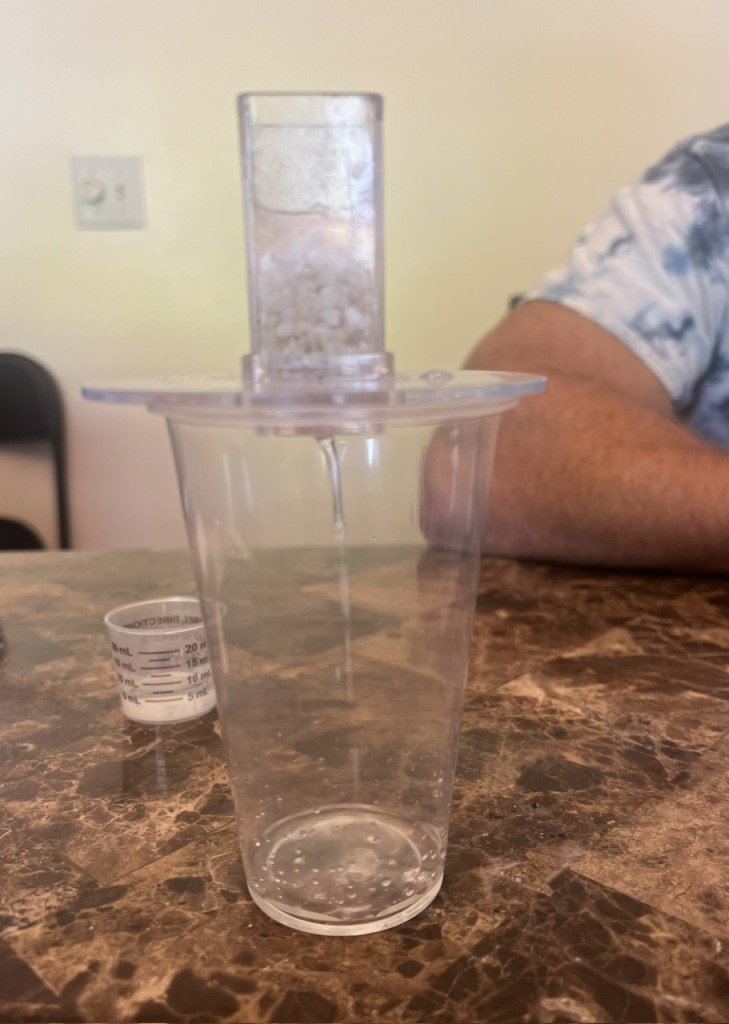
Permeability is closely related to porosity; however, it refers to how connected the empty spaces are to one another. Materials that have high permeability have pore spaces that are connected and allow water to flow through them. Materials that have low permeability have pore spaces that are not as well connected, or even isolated and will not allow water to flow through as freely.
To demonstrate permeability, lets have a water race! The following experiment uses the Clean Water Science filter sections, sand, and gravel.
- Use the sand and gravel cups from the Porosity Hack above. Remove the putty from the bottom of the filter section.
- Use your finger to plug the holes on the bottom of the filter cup. Carefully pour water into the cup to get the water to the top of the filter section.
- Remove your finger and allow the water to drain.
- Using a stopwatch, record how long it takes for the water to drain.
- Repeat the experiment with the other, sand or gravel, filter section and compare the results. Which material won the race? What does that say about each materials permeability?
- Alternative: If you have someone helping you out, you can remove the putty from each section at the same time and see which one wins the race!
Have you ever hacked a STEM experiment? Is there a kit you’d like to see us hack? Let us know in the comments section below!
 Education With Parents