

Recommended Grades: K through 3
Earth’s Interior Activity
Check out this Earth Day activity we put together for our son’s 1st grade class. We are so excited to share this with you!
The kids will learn about the different layers of Earth while building a cool model to show off! Test your kids knowledge with GeoKidz Earth’s Interior worksheet. Don’t worry we didn’t forget the younger kiddos. We also have included a Earth’s Interior coloring sheet.
Click here to get your downloads.
Activity: Build a Model of the Earth’s Interior
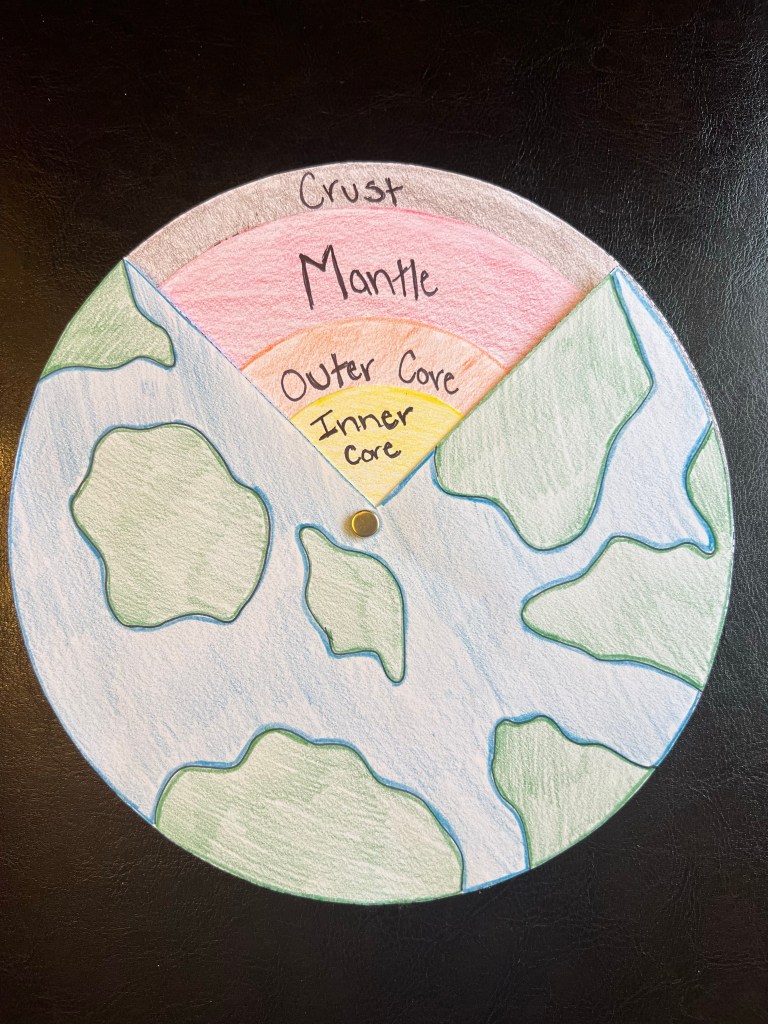
Materials Needed:
- White Card Stock (or Colored Cardstock)
- Crayons or Colored Pencils
- Scissors
- Glue
- Sharpie
- Fasteners (optional)
Instructions:
- Print out your pieces. (If you are using colored cardstock, pick your colors for each layer.)
- Color one 8″ circle for your crust, the other 8″ circle (with a piece to be cut out) for your Surface,
- Draw 3-4 Continent shapes on the 8″ Circle (Surface) and color them in prior to coloring the ocean.
- Color the 7″ circle for your Mantle, the 4.5″ circle for your outer core, and the 3″ circle for your inner core.
- Cut out circles along dotted lines.
- Label each layer accordingly:
- Crust: Thickness; 3 to 30 miles (other facts: rigid, thinnest layer, about 1% of the Earth’s total volume)
- Mantle: Thickness; 1,800 miles (other facts: ductile, dense, makes up over 80% of the Earth)
- Outer Core: Thickness; 1,370 miles (other facts: dense, hot, made up of nickel and iron, liquid)
- Inner Core: Thickness; 375 miles (other facts: very dense and hot, made up of iron, solid)
- Assemble and glue your layers.
- Lay-down crust first
- Glue Mantle on top of Crust
- Glue Outer Core on top of Mantle
- Glue Inner Core on top of Outer Core
- Place Ocean on top of all (glue down if not using a fastener)
- Take fastener and poke it through the center of your earth. (we used a thumbtack to make a hole first.)
Things to learn
Earth’s interior is divided into three major units: the crust, the mantle, and the core. The distinction between each unit is generally based on density and temperature. Additionally, the core is divided into an inner and outer core. Building a model of the Earth’s interior can help to understand the different characteristics of each layer.
The Crust
The crust is the outermost layer of Earth and is the rigid, rocky surface we are all familiar with. As you can see in our Earth’s interior model, it is also the thinnest layer. It ranges from about 3 to 30 miles thick! Can you guess where we find the thinnest crust? What about the thickest?
If you guessed that we find the thinnest crust beneath the ocean and the thickest beneath large mountain ranges, you are correct.
The crust is mostly made up of relatively low-density rock. The crust is also divided into oceanic crust and continental crust. As you also might guess, the oceanic crust is the material we find beneath the oceans and is mostly made up of dense igneous (volcanic) rock. The continental crust is the material we find beneath the continents and is made up of slightly less dense, silicate rich, material.
The Mantle
The mantle lies beneath the crust and makes up over 80% of Earth’s interior. It is about 1,800 miles thick. The mantle is more dense and hotter than the crust. The temperature of the Earth increases with depth. Temperatures in the mantle are usually close to the melting temperature of the material. This allows the material to behave in a more ductile manner, meaning the material can flow and deform.
What is the source of heat within the Earth? Several sources of heat account for the increase of temperature in the Earth. First, residual heat was trapped during the original accretion of Earth. This heat is mostly stored in the core. Also, spontaneous decay of radioactive elements contributes to Earth’s heat.
The Core
The core consists of very dense material and is mostly made of iron and nickel. During formation of the Earth, our planet got hot enough to melt iron, or about 2,800 degrees Fahrenheit. This episode is called the iron catastrophe. The iron catastrophe allowed more movement in Earth’s molten material, and heavy metals such as iron and nickel gravitated to the center of Earth forming the core. The current temperature of the core is estimated in the range of about 7,950 degrees Fahrenheit to over 10,000 degrees Fahrenheit. This is comparable to the temperature on the surface of the sun!
The outer core is liquid, and in fact, the churning metal (known as convection) of the outer core creates the Earth’s magnetic field! The outer core is about 1,370 miles thick.
The inner core is a very hot, dense ball of mostly iron with a radius of about 750 miles. The inner core’s intense pressure prevents the inner core material from melting.
Looking to learn more about the Earth’s Interior, go check out GeoKidz’s Ultimate Kit.

The Ultimate Geology Kit will guide you through important geology concepts including the Earth’s interior, crystal properties, mineral, and rock identification, and so much more with fun and exciting activities. Click HERE to learn more.
 Education With Parents