

Recommended Grades: K Through 5th grade
Freezing Point Depression
This experiment explores freezing point depression by making ice cream! We love doing this chemistry experiment at home. The kids learn so much; from following procedures, measuring ingredients, making observation, and some awesome science! The best part, the experiment ends with a tasty treat and little mess to cleanup afterwards.
Of course, we like to try and make the connection from our kitchen lab to the real world, and more specifically geology. Check out our learning goals for discussions to help make this connection.
Materials needed for this experiment
- 1/2 cup heavy cream
- 1/2 cup half-n-half (or milk)
- 1/2 tsp vanilla
- 3 tbsp of sugar
- Ice
- Rock salt
- Gallon sized freezer bag
- Quart sized freezer bag
- Other option:
- Play and Freeze Ice Cream Ball (buy here)
- Optional – 3tbsp of pureed fruit of your choice
The procedure
- Mix together the heavy cream, half-n-half (or milk), vanilla, and sugar in the quart-size bag. (or in the Play and Freeze Ice Cream Ball) If you decided to add pureed fruit, mix in this ingredient as well. Close the bag and make sure it is completely sealed.
- Fill the gallon-size bag about ¾ the way full of ice and add about ¼ cup of rock salt.
- Place the quart-size bag of ice cream ingredients into the gallon-size bag of ice and salt. Seal the gallon-size bag.
- Shake the bags for about 10 minutes. The bag gets really cold so you might try wrapping a towel around the bag. (Que favorite song, we like to turn this step into one epic dance party!)
- Open the bag carefully – don’t let the salty ice water mix with your ice cream!
Learning goals and discussion topics
Depending on your child’s age, they might already know that water usually freezes at 32 degrees Fahrenheit. This is its freezing point, or the temperature at which a liquid becomes a solid. For my 5-year old, this experiment was a great opportunity to reinforce this knowledge. Most probably don’t know that ice cream usually freezes at about 27 degrees Fahrenheit. So, the idea I try to teach here is that different materials have different freezing points.
And this raises the first question:
If the ice is 32 degrees Fahrenheit, but ice cream needs to be even cooler to freeze, then how can the ice make ice cream?
The answer: Because the salt lowers the freezing point of water! Compounds like salt that break into two pieces (sodium and chloride) when dissolved, will disrupt the ability of water to form ice crystals. This is known as freezing point depression.
Next question:
Where else do we see freezing point depression in everyday life?
Winter can get cold where we live so kids are quick to recognize placing salt on the sidewalk will melt ice. Another example is adding antifreeze to vehicles.
Finally, how about some geology-related discussion:
What kind of rocks form when a liquid turns into a solid?
Igneous – Igneous rocks form when hot, molten magma or lava cools and solidifies.
Do different minerals solidify at different temperatures?
Yes! In the early 1900s, N.L. Bowen began studying the order of crystallization of the common silicate minerals that form from a magma. This led to our current understanding of the general model for how a magma evolves as it cools, and what Bowen found was specific minerals form at specific temperatures as a magma cools. Bowen’s Reaction Series is shown below.
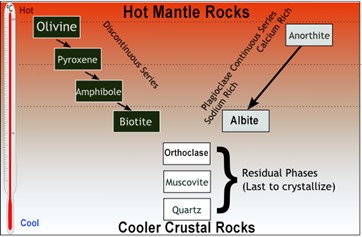
The branch on the left describes how mafic minerals form, while the branch on the right describes how plagioclase feldspars evolve from calcium to sodium rich. At low temperatures, the branches merge and we find the minerals common to felsic rocks.
 Education With Parents